Learning Outcomes:
i. Define gastrulation and its significance in embryonic development.
ii. Identify the key cell movements involved in gastrulation and their consequences.
iii. Explain the formation of the three primary germ layers and their future roles in the organism.
iv. Appreciate the intricate choreography of cell interactions during gastrulation and its impact on shaping the embryo.
Introduction:
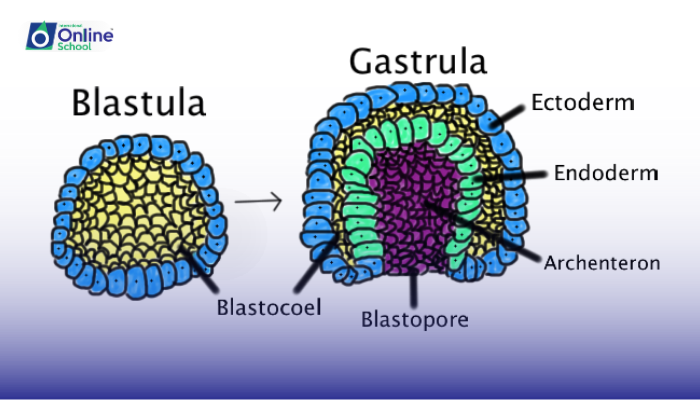
Imagine a hollow ball of cells, brimming with potential. This is the blastula, a stage in early embryonic development where seemingly identical cells hold the blueprint for an entire organism. But how does this simple ball transform into a complex being with distinct tissues and organs? The answer lies in a remarkable process called gastrulation. In this lesson, we'll journey into the heart of gastrulation, witnessing the awe-inspiring movements and interactions that orchestrate the creation of the body's fundamental building blocks.
i. The Curtain Rises: Cell Movements Take Center Stage
Gastrulation is not a passive unfolding; it's a dynamic ballet of cell movements that reshape the blastula:
Invagination: Imagine poking your finger into a balloon. This inward movement, called invagination, occurs when cells on the blastula's surface push inwards, creating a groove that deepens into a pocket.
Epiboly: Like a spreading sheet, cells from the upper part of the blastula (epiblast) glide over the invaginated cells, covering and enclosing the developing embryo.
Delamination: Within the blastula, cells peel away from each other, forming distinct layers.
ii. The Layers Unfold: From Three to Many
Through these movements, three primary germ layers emerge:
Ectoderm: The outermost layer, destined to form skin, hair, and nervous tissue.
Mesoderm: The middle layer, giving rise to muscles, bones, blood, and many other organs.
Endoderm: The innermost layer, forming the lining of the digestive and respiratory systems, as well as internal organs like the liver and pancreas.
iii. From Blueprint to Building: The Legacy of Gastrulation
These newly established germ layers are the canvas upon which the embryo's future structures are painted:
Each germ layer possesses unique genetic instructions, guiding it to develop into specific tissues and organs.
The interactions and signaling between these layers determine the intricate architecture of the body.
iv. The Choreography of Life: A Marvel of Evolution
Gastrulation is more than just a series of movements; it's a testament to the exquisite choreography of life. Every bend, twist, and interaction between cells plays a crucial role in shaping the embryo's future. Understanding this process allows us to appreciate the incredible complexity and adaptability of life on Earth.
Gastrulation, with its dynamic cell movements and the creation of the three germ layers, marks a pivotal turning point in embryonic development. It is a process full of wonder and intricate choreography, laying the foundation for the diverse tissues and organs that will define the future organism. As we unravel the mysteries of gastrulation, we gain a deeper understanding of the remarkable journey from a single cell to a complex being, a testament to the power and elegance of life's grand design.
